 VANTAGE Windows & Doors
 Roofing Industries
 ALTHERM Window Systems
 Dimond Roofing
 Juralco Aluminium
 dormakaba


 Prolam
 Case Studies
 PGH Bricks
 Metwood




 GIB
GIB
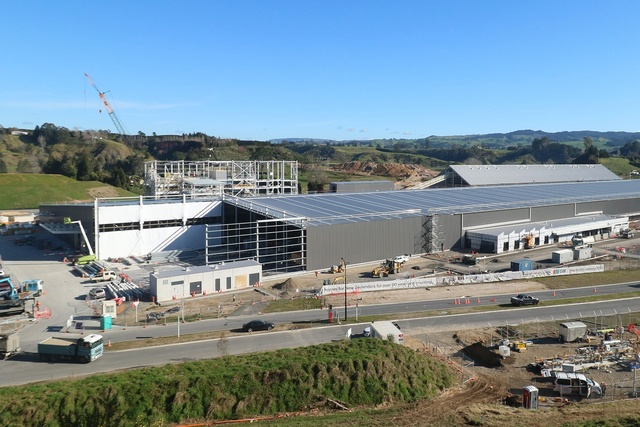

Spanning a massive 120 metres wide by 400 metres long, Winstone Wallboards' new Tauranga facility is one of the largest single level buildings in the country — but it’s the commitment to safety, rather than the scale, that truly sets this development apart.
“If you start with safety, everything else follows,” says Shaun Sanders, Winstone Wallboards Tauranga Engineering Manager, a driving force behind the design and installation of the plant. “When you’re delivering a $400 million facility for Fletcher Building, safety can’t be an afterthought. It was critical to us that no one was harmed during construction or operations, and that commitment shaped our strategy from day one.”
Machine safety and risk management company TEG Risk and Sustainability Services was brought onboard from the get-go to lead the Safety in Design process, applying their specialist knowledge to identify risks and embed safety into the project.
Adds Shaun, “We spent nearly two years working closely with TEG and the overseas vendors before construction even began, holding weekly calls to conduct risk assessments, HAZOPs, and design reviews. It was an enormous amount of work and required a significant time investment, but the results speak for themselves.”
Now Winstone Wallboards has a plant that’s not only built to spec, but built to protect, and Shaun couldn’t be prouder.
“I’m incredibly proud of the trust our people have in the systems we’ve built,” he says. “Whether it’s using a gate to clean a machine or isolating a section of the plant, they know they’re safe. That trust is real, and it’s saved us time, money and most importantly — injuries.”
For TEG Risk Director and founder Hamish Baker, the Tauranga Facility has been a dream project, and one of his top two career highlights to date.
“Safety in Design is not something that New Zealand does particularly well. We’re definitely behind Australia and eons behind the UK in terms of health and safety, but Winstone Wallboards had done something really special here,” says Hamish, who was engaged in the project from end-to-end, facilitating the HAZOPS, sitting in as technical expert on machinery risk assessments, completing final verifications and validations, and even developing an app to make risk assessment and safety information accessible to Winstone Wallboards operators on mobile devices.
“While TEG Risk has contributed a lot to this project, we couldn’t have achieved what we did without the outstanding leadership of Shaun and his team. It’s because of Winstone Wallboards’ leadership and commitment to safety that we have the plant that we do.”
One of the stand-out features of the facility is a groundbreaking remote isolation system that enables large sections of the plant to be quickly and safely isolated.
Says Shaun, “Isolation is often a complex and overlooked part of industrial safety and in many cases it’s misused to gain time advantages in manufacturing. I led the initial design and sent it out for peer review among industry experts to ensure we were meeting the highest standards. We received a number of recommendations and made the decision to implement every single one — not just the required ones — because we believed that every step toward protecting our people was worth it. I believe this is a groundbreaking development in Safety in Design for New Zealand and I’d encourage other companies to look at what we’ve done and consider adopting similar measures.”
Winstone Wallboards provided invaluable technical input around plasterboard manufacturing and operational readiness, collaborating closely with TEG Risk and the machinery supplier to meet safety and performance goals. Plant layout was uniquely designed to minimise the overlap of zones in hazardous areas (resulting in reduced compliance requirements, fewer ignition sources and enhanced safety), and alternative solutions were found to address Fletcher Building’s non-negotiable safety rules (such as working under suspended loads).
These are just a few of the clever ways the team has reduced risk, but it was development of ‘Appendix A’ — a contractual document outlining the key safety features and standards the plant had to meet — that was the real game-changer.
Says Hamish, “Winstone Wallboards got very detailed in their contract specifications, so that nothing was left open to interpretation. By setting expectations early, they avoided time-consuming discussions around what did or didn’t need to be done. That meant there were no distractions to take away from the core objective — to build the safest plant possible and get it up and running.”
Not only that, but by building robust safety processes into the contract, the supplier couldn’t just build the plant, they had to have their risk assessment reviewed and signed off before they did so.
“That enabled us to catch compliance issues before they were engineered which saved a lot of money, and we also eliminated some risks by designing them out of the process,” explains Hamish. “I believe a combination of that front-end Safety in Design approach pre-contract, really clear specifications in the contract, and all the desktop risk assessments and HAZOPs we had before the build even started, had a massive impact on the success of the plant.”
Winstone Wallboards’ Tauranga Facility is a shining example of how Safety in Design can be embedded from the very outset of a project and deliver an outstanding result. And that’s a lesson Shaun believes could be applied right across the sector.
“Safety needs to be a fundamental part of the design from the very beginning,” Shaun says. “That’s why we made ‘Appendix A’ the first dependency in every contract. It was the first document anyone saw, and it clearly demonstrated our commitment to safety. By setting that expectation upfront, we created alignment across all stakeholders and ensured that safety was built into every decision.
“When people understand what they’re trying to achieve and why it matters, it creates alignment and momentum. We developed a strong foundational framework that guided our decisions throughout. So when questions came up about specific machines or processes, we could refer back to our original documents — and that clarity often resolved issues before they escalated.”
That’s not to say it didn’t also dish up a few challenges.
“There were moments when we had to ask ourselves, ‘Have we gone too far?’ especially when some of the OEMs pushed back against what they saw as excessive safety requirements. But we held the line,” says Shaun.
“Those high expectations created some very complex engineering challenges, which we spent years working through collaboratively — both here in New Zealand and with our international partners. It wasn’t easy, but it was worth it to ensure we achieved the level of safety we set out to deliver.”
Winstone Wallboards hasn’t just built a new plasterboard manufacturing facility; they’ve embedded safety into its DNA, from concept to completion.
Designed to ensure continuity of supply across New Zealand, this new plant will meet growing demand in the construction sector for many decades to come. But was it worth the considerable investment?
“Absolutely,” says Shaun.
“Safety in Design can be a significant financial investment, but in my view, it pays for itself well before the project is even completed. When safety is embedded from the start, you avoid costly redesigns, delays, and reactive fixes during construction. You know the plant is going to be safe, which streamlines decision-making and builds confidence across the board."
“I don’t see it as a financial burden at all — I see it as a cost-saving measure. Done well, it delivers value throughout the design phase, into manufacturing, and long into operations. And even if it were purely a financial investment, the moment someone gets hurt, the cost to the business becomes irrelevant. The personal cost to that individual — and their family — is something you can’t put a price on. That’s why we do it.”
 Popular Products from GIB
 Most Popular
 Popular Blog Posts