 VANTAGE Windows & Doors
 Roofing Industries
 ALTHERM Window Systems
 Dimond Roofing

 Juralco Aluminium
 SPAX


 Prolam
 PGH Bricks
 Metwood






 MyImprint | myimprint.nz

 Most Popular
 Popular Products
1
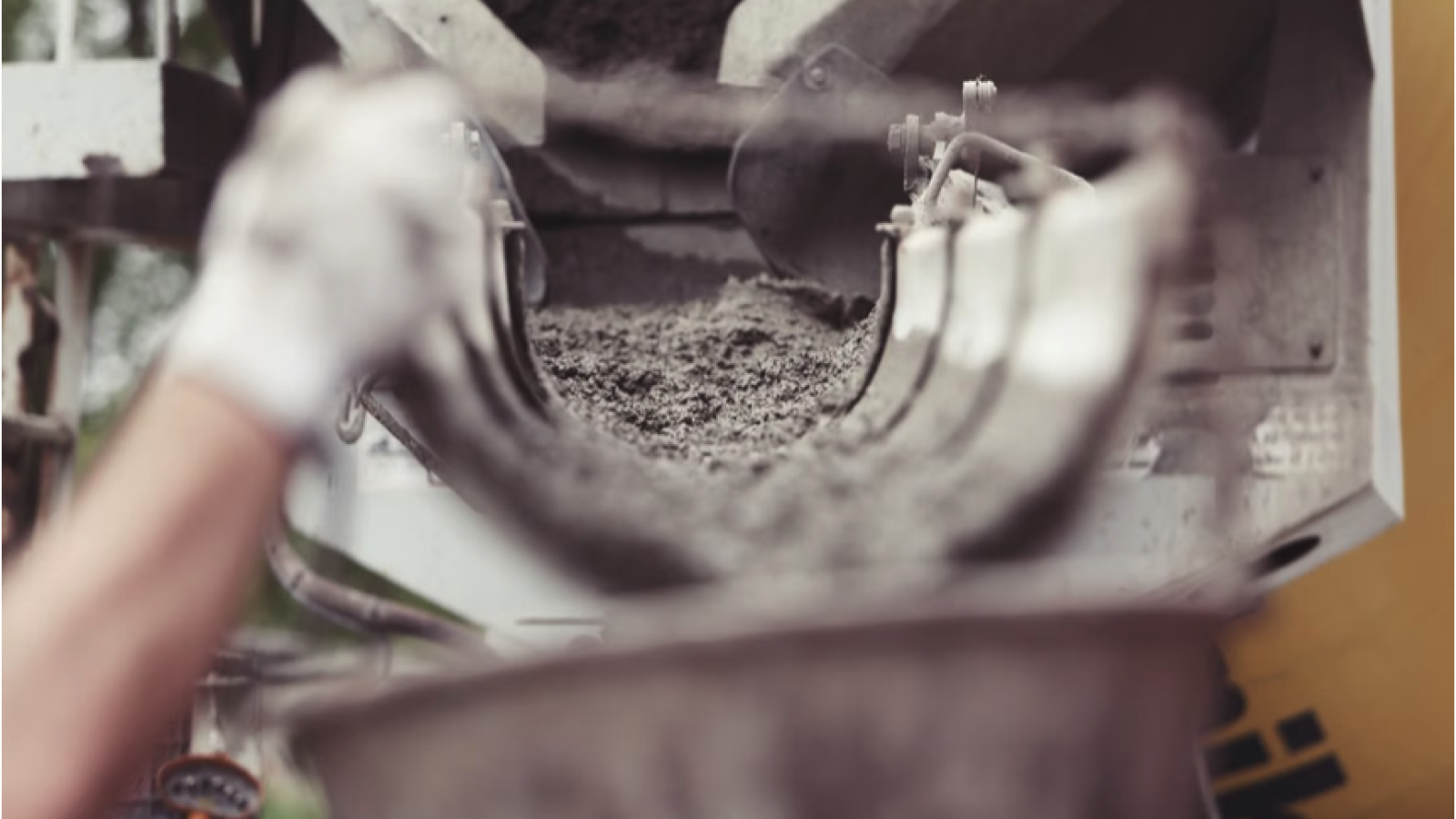
A standard 25 MPa ready-mix concrete has roughly 0.10 kg CO₂e emissions per kg of concrete¹. Because concrete is heavy and used in large quantities in buildings — such as in concrete slabs — it is often the single biggest source of embodied carbon in a building.
Per kilo, concrete is one of the lower-carbon materials you’ll specify. Reinforcing steel, by comparison, can be over 30 times more carbon-intensive by weight (SESOC, 2024). However, the issue is quantity. In the average 200m² house modelled for the NZ Green Building Council’s Under Construction report (2019), the slab and footings alone weigh about 68 tonnes by our estimate — nearly half the weight of the whole house, and more than four times the weight of the timber, plasterboard and roofing put together.
Figure 1 below shows the contribution to emissions from each building element. Because the slab is such a large share (about a third), switching to a low-carbon mix can make a real reduction in carbon emissions. Based on our calculations, we estimate that carbon emissions would fall by 5 - 8% across the house's building materials using low-carbon concrete.
Low-carbon concrete itself typically has 10 - 50% lower carbon emissions than a standard mix and might add roughly $0 - 500 to the total cost of the concrete materials for the entire house.
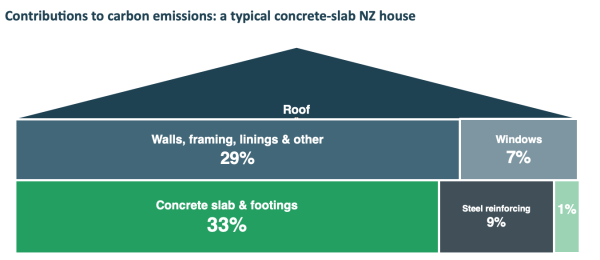
Figure 1. Embodied carbon of the building materials (A1–A3) in an average 200m² concrete-slab, timber-framed New Zealand house. The thin strip at bottom right is hardfill and slab insulation (1%). Uses NZGBC (2019) concrete data (about 0.16kg CO₂e/kg), which is higher than current figures, so the slab’s share may be overstated.
Is low-carbon concrete worth it?
After you have avoided and reduced material use where you can, swapping to low-carbon concrete can be good value for money.
We wanted to know if low carbon concrete is worth the money, so we did some investigation.
We talked with East Coast Concrete in Gisborne, who said that for 20 MPa concrete, the standard and low-carbon mixes were the same price. That’s a carbon saving at no extra cost.
To find out more about the pricing, we spoke with Senthooran, Project Manager from Civil Assist, who previously worked for Holcim for six years. He said that low-carbon cement uses fly ash or slag. These are by-products of other processes, so depending on where the cement plant is located, low-carbon cement could even be cheaper than traditional cement.
Beca’s analysis for the NZ Green Building Council (2026) estimates that low-carbon concrete costs about 2% more for every 10% cut in carbon. For this house, that would mean roughly $330 - 500 extra for 28m³ of concrete, based on their figures.
To sum up, low-carbon concrete may cost you $0 - 500 extra in the slab materials, which could be under 0.1% of your total build cost. That’s good value.

Figure 2. MyImprint estimate of switching the slab and footings of the NZGBC average house to a low-carbon mix, using NZGBC (2019) for carbon (Table 1), a Gisborne supplier quote, and the Beca for NZGBC (2026) cost rule of thumb with rough NZ price quotes.
Some caveats
If a product has an EPD (environmental product declaration), you can see a range of environmental impacts, not just carbon, and low-carbon concrete often performs better on several of them. That’s partly down to the reporting rules. Fly ash (from coal-fired power stations) and slag (from steelmaking) are usually treated as waste or low-value by-products, so little or none of those industries’ emissions are counted against the concrete.
Toxicity is the main question mark for low-carbon concrete. Fly ash and slag can contain heavy metals, so low-carbon concrete can score worse on toxicity indicators.
Low-carbon mixes can also gain strength more slowly and take longer to set (NZGBC, 2019), which can affect formwork and construction programmes, especially in cold weather.
Our take
For most projects, low-carbon concrete is a good-value change if you are trying to reduce your carbon impact. Get your own quotes, because low-carbon concrete can be cost-neutral.
If you want to know more about carbon assessments, LCAs or EPDs, call MyImprint for a chat.
Appendix: Where the numbers come from
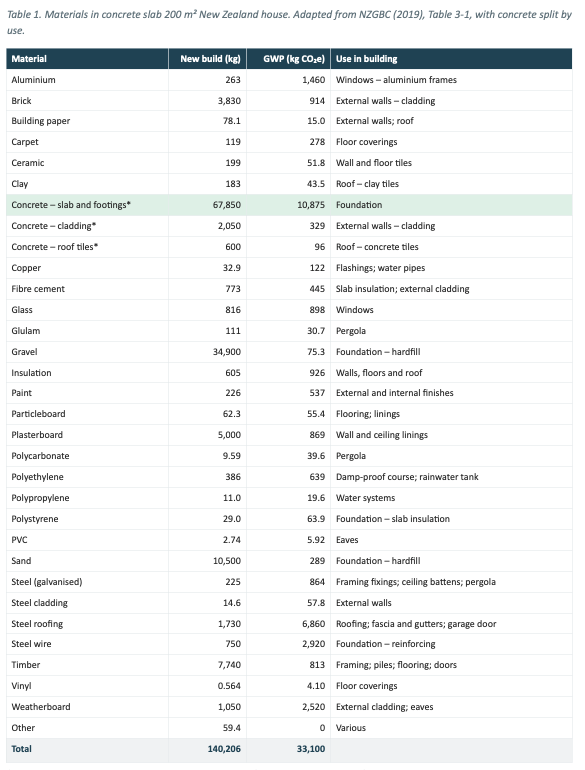
* MyImprint estimate. Table 3-1 reports concrete as one line (70,500 kg; 11,300 kg CO₂e). We estimated the roof tiles at about 600kg by scaling the clay roof tiles (concrete tiles cover 6% of roofs, clay 2%) and allowing for concrete tiles being slightly heavier than clay, which leaves about 2,050kg of concrete cladding.
¹ A standard 25 MPa ready-mix concrete has around 230–248 kg of CO₂e per cubic metre (SESOC, 2024).
Sources:
- Beca for NZGBC (2026). Pathways for achieving Green Star upfront carbon targets.
- Gisborne ready-mix supplier (2026). Price quote for standard and low-carbon 25 MPa concrete (personal communication).
- NZGBC (2019). Under Construction: Hidden emissions and untapped potential of buildings for New Zealand’s 2050 zero carbon goal, v1.3. Prepared by thinkstep-anz.
- Senthooran, Project Manager, Civil Assist (2026). Discussion of low-carbon concrete and cement pricing (personal communication).
- SESOC Sustainability Task Force (2024). Top Tips for Low-Carbon Design, BRANZ External Research Report ER86.