 VANTAGE Windows & Doors
 Roofing Industries
 Blum
 Dimond Roofing
 ALTHERM Window Systems

 Juralco Aluminium



 Nuralite

 GreenStuf
 MiTek New Zealand Limited







 YourQS
How much faster
Let’s look at two cars. Car A travelling at 100pkh, Car B at 75kph. The difference in speed between them is 25kph.
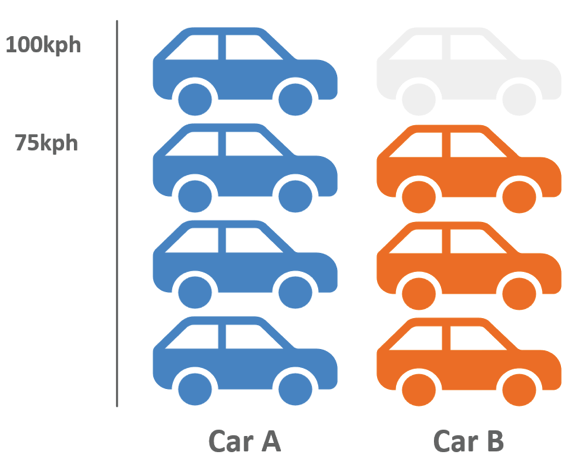
What is the relationship between them? It depends on your perspective.
- How much must Car B increase its speed by to match Car A: 25/75 or 33%
- What reduction does Car A need to march Car B: 25/100 or 25%
The speed change is the same, 25kph. The percentage change depends on which Car A or Car B you are in. It changes with your perspective.
It is the same for margin and markup
It depends on whether you are looking at the profit from the perspective of the cost or the selling price. If you have a job or product that costs $75 and you sell it for $100 your profit is $25.
If you want to make $25 profit you must markup the cost by 33%. $75 + (33% x $75) = $100.
When looking at the $100 sale price, the profit portion of this is $25 so the margin is $25/$100 = 25%.
A 33% markup returns you a 25% margin.
Why margin matters?
Looking at your business is not like looking at the costs on a project. With a project, typically your starting point is the build cost, and you work up from there. You can’t do this when looking at your business annual accounts or preparing budgets. The cost of sales is a result rather than a starting point.
We’re in business to make a profit
To run a profitable business, you must be able to look at your turnover and know how much gross profit you need on your sales to cover your costs and make a return. When you are looking at turnover, you are looking from the perspective of the sale price.
Say your business has a gross profit of 25%:
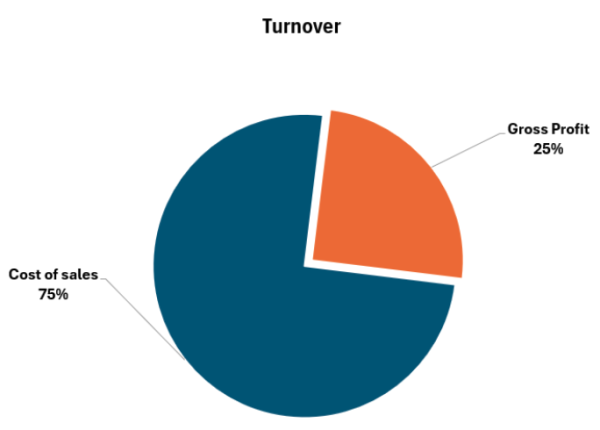
To survive, you must cover your overheads from this gross profit. To thrive, there must be net profit too.
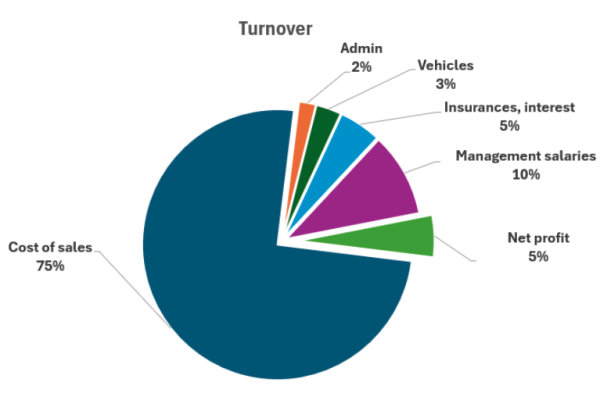
It is important to know the gross margin percentage your business must achieve to thrive. Once you know the margin required, then you have a target for every job. Once you know the cost, you then must mark it up to achieve your target gross profit.
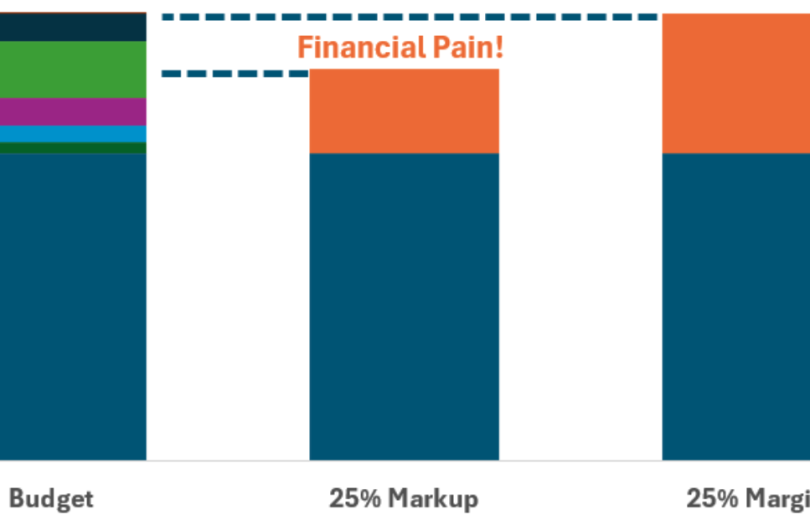
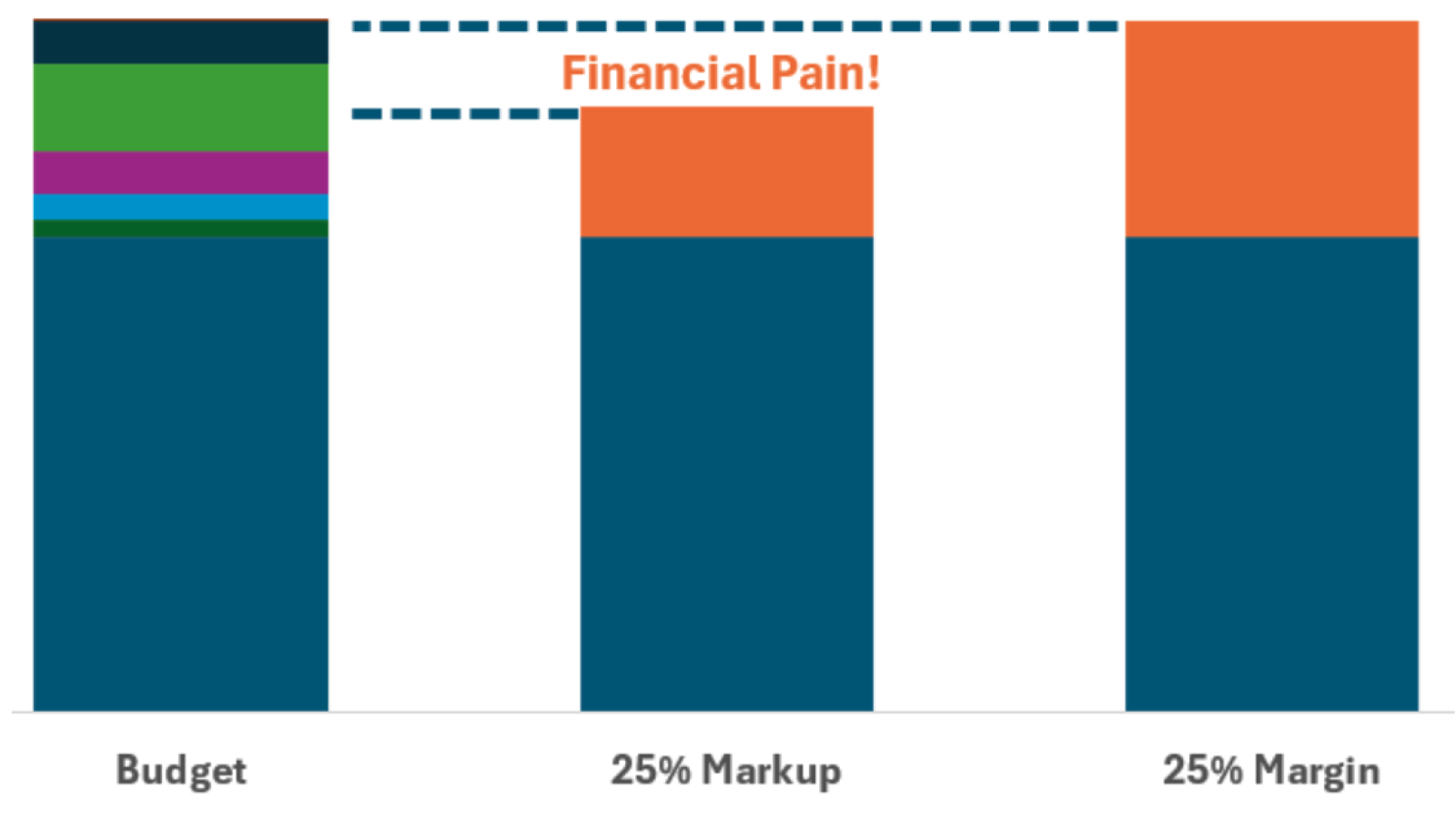
In this example, I need 25% margin to make my 5% net profit. Getting to this from your build cost means you must know the “markup to margin flip”. If I apply 25% markup instead of 25% margin, it hurts!
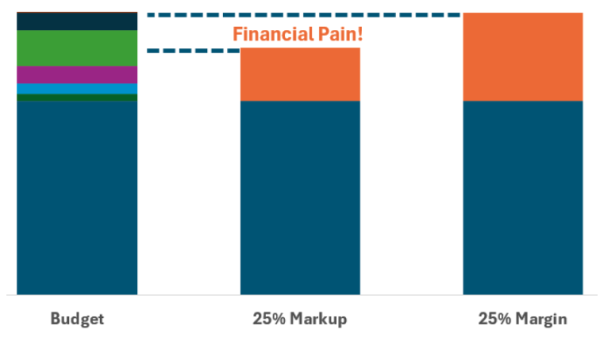
The markup to margin flip
Being able to flip between margin and markup is a useful skill for managing your business profitability. Here are some common margins and markups:
| Markup | Margin | Divide cost by* |
| 10% | 9.1% | |
| 11.1% | 10% | 0.9% |
| 15% | 13.4% | |
| 17.65% | 15% | 0.85 |
| 20% | 16.7% | |
| 25% | 20% | 0.8 |
| 30% | 23.1% | |
| 33.3% | 25% | 0.75 |
| 42.8% | 30% | 0.7 |
| 53.8% | 35% | 0.65 |
*Tip:
An easy way to apply a margin is to use what I call the “minus 1 divide by method”. That is, divide the cost by one minus the margin percentage. For example:
1 – 15% = 0.85
(Cost divided by 0.85 equals a sell price at 15% margin)
Using our example numbers
$75 / 0.75 = $100
Note from a marketer about cost plus
Remember, your price is only part of the story.
What I have been outlining is a cost-plus approach. Work out your cost, then apply the profit you require. This method works and is commonly used in the construction sector as it is easier for us to determine our cost. There is a risk with this though that you either leave money on the table, or your price is too high.
The marketer in me says you should be charging the maximum that the market will accept. I.e. work out what your client is willing to pay for the value that you provide. Then work out what your cost is. The difference is your profit. This might be more or less than you expect so you must decide it is acceptable.
If you have a very strong value proposition, it may well position you in the market to achieve a higher return than you expect.
It might surprise you what is possible.
About Nick Clements
Nick won the inaugural NZIOB 2024 Digital Technology award for his work on 3D estimating in residential construction. He is a Registered Quantity Surveyor and chair of the NZIQS Auckland.
His business, YourQS, specialises in providing cost estimating services to residential builders, architects, and homeowners for both new build and renovation projects. They have completed over 4,000 projects since launching in 2019 working with around 350 builders nationwide.
Nick is the host of the Beyond the Guesstimate podcast where he talks with interesting people ideas on how we can improve as an industry and as businesses within it.

 Most Popular
 Popular Products