 VANTAGE Windows & Doors
 Roofing Industries
 ALTHERM Window Systems
 Dimond Roofing
 Juralco Aluminium
 dormakaba


 Prolam
 Case Studies
 PGH Bricks
 Metwood





 Rondo Building Services


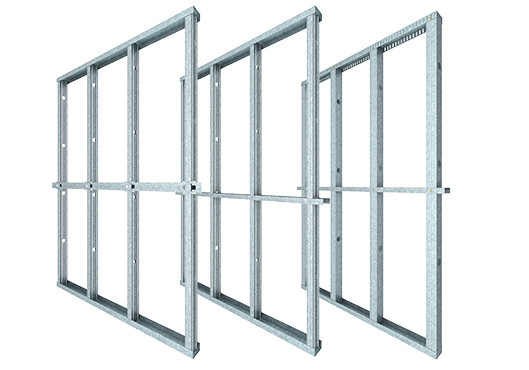


For lightweight steel framing products, zinc coatings are vital to ensure steel durability. They provide a sacrificial shield that guards against corrosion and extends a product's lifespan. Unfortunately, some imported products readily available in the market have lower zinc coatings to cut costs, leading to faster corrosion and shorter product life.
Over a 24-month investigation, testing at Rondo confirmed that most imported steel products included in these tests had a Z100 zinc coating — a significantly lower coating when compared to Rondo steel products, which are typically supplied as Z275.
Z275 contains 175 g/m² more zinc than Z100, equating to 175% greater zinc protection. This additional coating thickness provides substantially enhanced corrosion resistance, particularly in environments subject to moisture and condensation.
Rusting beads in brand new homes causing rework costs
Rondo were recently contacted about multiple new homes where imported corner beads were rusting through finished walls. Testing found the products had an alarmingly thin Z70 zinc coating, and in some areas, the coating had been completely removed during manufacture, leaving no protection against corrosion across parts of the bead.
Performance implications of low zinc coated products
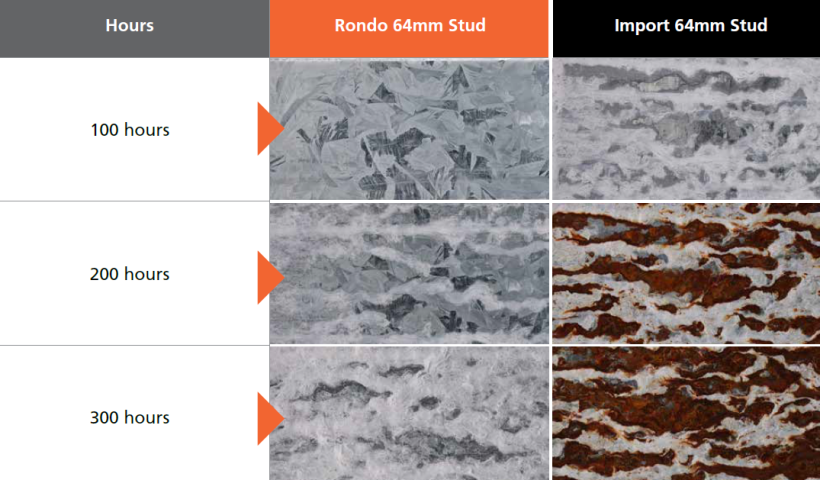
Rondo recently completed Accelerated Corrosive Environmental Testing at an independent laboratory. In this test, a continuous salt mist was sprayed onto both Rondo and imported steel components, with images captured at regular intervals.
Before testing commenced, the imported steel samples showed visible surface defects. By 200 hours, red rust had already formed on the imported steel due to coating failure, and by 400 hours significant corrosion was evident. In contrast, the Rondo samples displayed no visible red rust over the same testing period.
What does this mean for performance of low zinc-coated products?
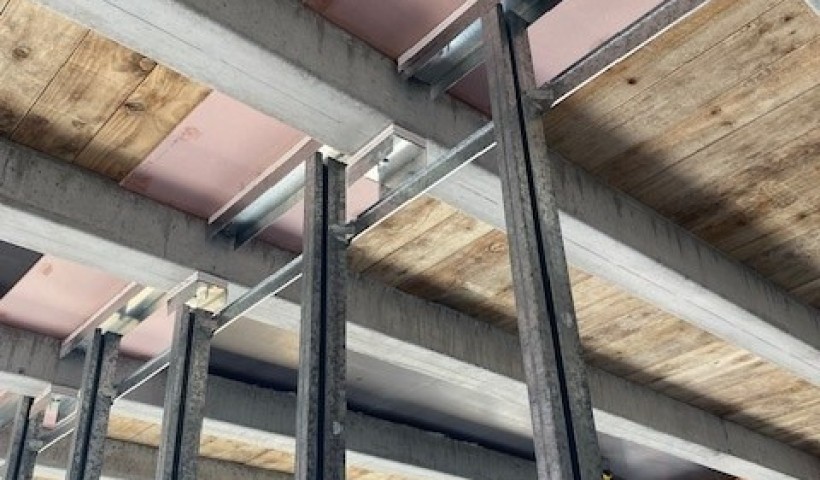
The results of the accelerated corrosion testing are unmistakable: low zinc-coated Top Hats corrode significantly faster, and once the protective coating fails, the underlying steel deteriorates rapidly. This early breakdown has major implications for façade systems, where steel Top Hats are critical to structural performance, fire safety, and weatherproofing.
Coating failure and corrosion in Top Hats can impact real building performance, and lead to:
- Structural adequacy issues
- Fire performance risks
- Waterproofing issues
Why rusted top hats can no longer support your façade
Red rust can expand up to 10 times the volume of steel, so when corrosion begins, it progressively eats away at the material while also causing surface expansion.
As corrosion progresses, it results in:
- Reduced steel thickness, lowering the load-carrying capacity
- Weakened connections, particularly fasteners fixed into the corroding Top Hat
- Distortion or buckling, as volumetric expansion pushes the steel out of shape
In façade systems where Top Hats support cladding, these effects can cause:
- Sagging or displacement of cladding
- Premature fatigue and cracking
- Failure to meet design wind-pressure or structural performance requirements
Over time, corroded steel can no longer perform the way it was designed, compromising the stability of the entire façade assembly.
Rondo spent the past 24 months testing imported products, and heavily invested in in-house R&D, engineering, and software development, because standing apart matters.
With Rondo Systems, you can expect:
- Full compliance with NZBC and New Zealand Standards
- Guaranteed system performance as designed
- Extended warranty with our system guarantee
 Popular Products from Rondo Building Services
 Most Popular
 Popular Blog Posts