 VANTAGE Windows & Doors
 Roofing Industries
 Blum
 Dimond Roofing
 ALTHERM Window Systems
 Juralco Aluminium



 Nuralite
 GreenStuf
 MiTek New Zealand Limited








 pro clima
We’ve been promoting the practice of sealing up the external weathertightness layer for a while now, and the push-back we get at training events is surprising. But that push-back soon turns into acceptance once we explain the build sequence, show the performance improvement and demonstrate what the wall underlay can do.
The problem we’re solving is wind washing: air driven through gaps in the outer layer and through the insulation, carrying heat with it. It isn’t new. Bankvall showed the effect of wind and workmanship on insulation in 1978, and in 1991 Timusk et al. looked at wind washing in stud cavities, noting “…wind cooling of exterior corners, resulting in an increase of heat loss…” (cited in Straube & Smegal, 2018).
In the image below, wind pressure hits the wall from the left. Negative pressure forms on the leeward side, toward the top of the image. Wind is driven in through unsealed underlay laps, sucked through the insulation, and out again. Note this happens even with an internal airtightness layer in place (shown in red).
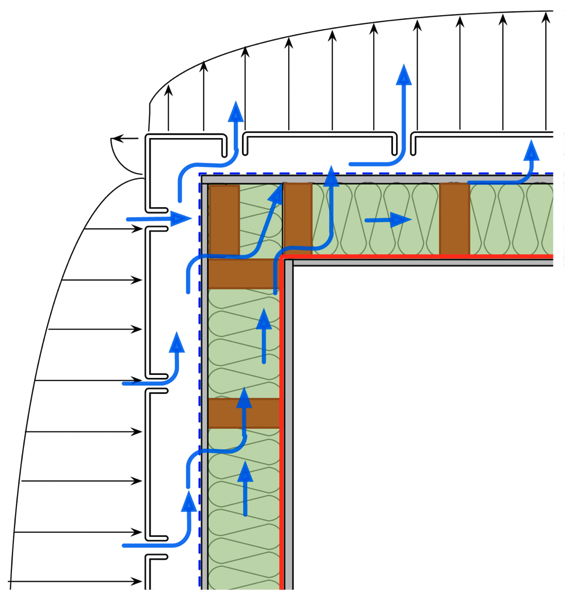
Wind washing flows through insulation within framed wall. Straube & Smegal (2018).
So the first message is: seal the laps together! If you can reach your hand through and touch the insulation, so can the wind. We sell tape, so yes, that’s a positive for Pro Clima. But the outcome is a positive for the building too: the insulation performs as designed and energy demand drops.
Laps are only part of the wind-sealing though. The next seal connects the base of the wall underlay to the slab edge or perimeter joist, and the head of the wall underlay to the top plate or soffit line. This is where the push-back starts: “What about drainage off the slab?” Fair point, but water on the slab is only an issue until the roof is on. So the answer is: once the roof is on and it’s time to close up the outside, seal the base to stop wind wash and drafts under the bottom plate. I like packers that lift the bottom plate out of the puddles during framing. But they leave big gaps once construction is done, and those should be covered and ideally insulated full depth, not just given a squirt of foam.
The next common objection is that sealing everything will trap moisture in the frame. This is where the sales pitch comes in, but really it’s just how SOLITEX membranes perform. They can’t let bulk water (liquid droplets) through the functional layer, so rain stays out even while the underlay is exposed during construction. That same performance supports ECI (Early-Close-In): insulation and moisture-sensitive plasterboard can go in before the cladding is on.
Installing insulation and plasterboard still depends on the timber frame being at or below 18% moisture content. That brings us to the other side of SOLITEX: vapour movement. It’s more than just letting moisture out. The membrane actively moves moisture along the polymer’s molecular chains, so it drives drying rather than simply allowing it.
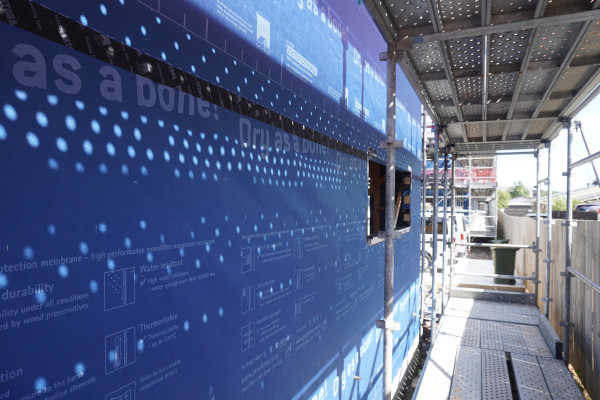
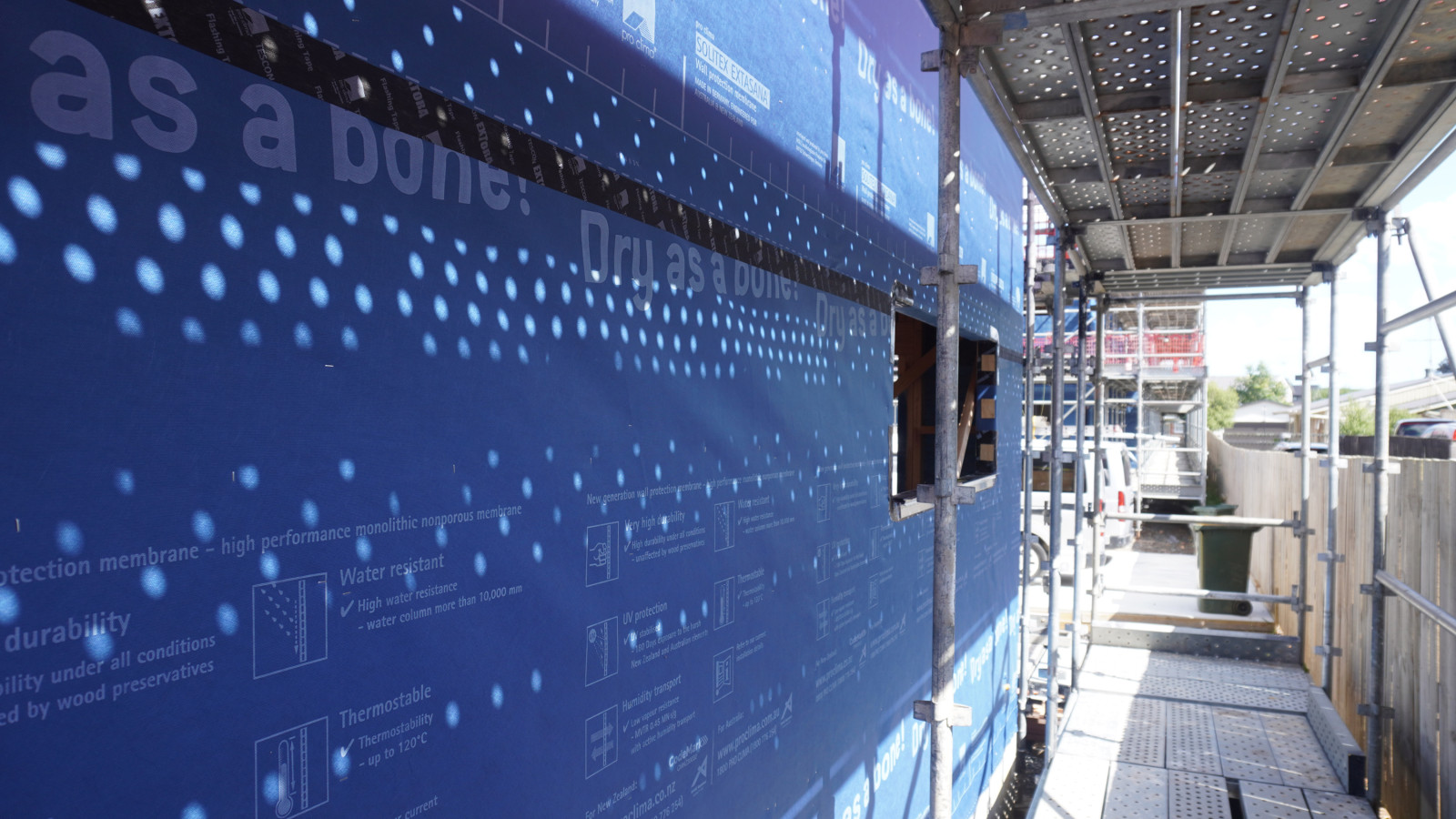
SOLITEX EXTASANA taped and sealed.
To wrap it up: we want to protect insulation from wind wash, so we seal the vertical and horizontal laps of the wall underlay, plus the base and head of the wall. The membrane’s performance is why we can safely seal every join: it keeps water out without trapping moisture in.
Author: Jon Davies, Technical Sales Support and Education Manager, Pro Clima NZ

 Most Popular
 Popular Products