 VANTAGE Windows & Doors
 Roofing Industries
 ALTHERM Window Systems
 Dimond Roofing
 Juralco Aluminium
 SPAX
SPAX



 Prolam
 PGH Bricks
 Metwood







 Allproof Industries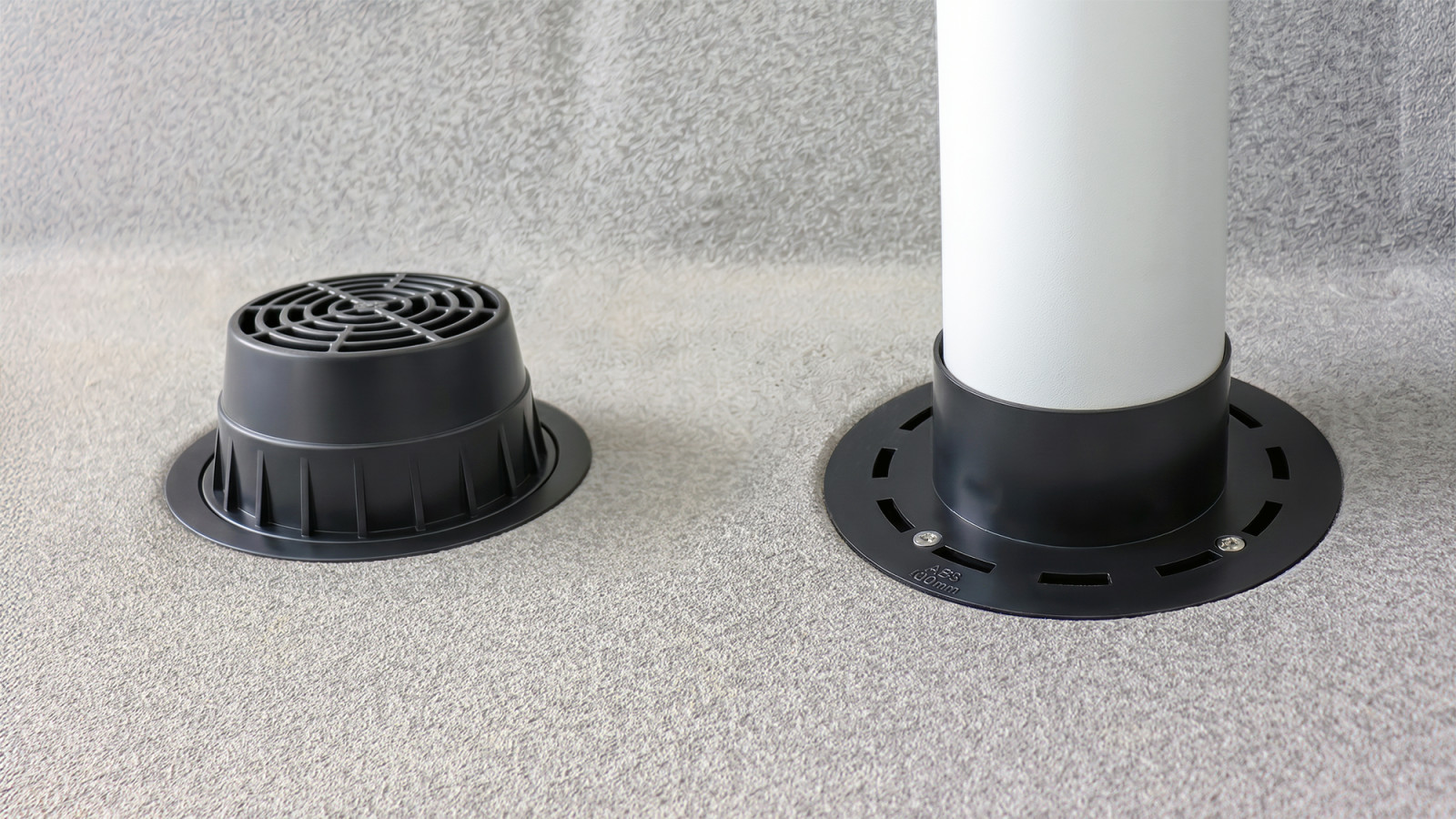
NZBC Clause E2/AS1 (paragraph 8.5.1.2) outlines the requirements for a membrane roof or deck, stating that there must be "no downpipe direct discharge to deck." Therefore, the design must accommodate both the downpipe penetration and the protection of the membrane at the termination point. Consideration must be given to the durability of the termination, ensuring the system avoids the likelihood of blockages and provides reasonable access for maintenance and clearing, in accordance with NZBC Clause E1.3.3 and E2(2.2).
Utilising a flange and clamped riser ensures the edge of the membrane has an acceptable surface for adhesion and a clamp to maintain that adhesion, complying with Waterproofing Membrane Association Inc (WMAI) codes of practice. The clamp incorporates a riser that receives the discharge from the downpipe, supports its base, and directs the flow to the stormwater pipe below. A PVC flange allows for a glued outlet, ensuring the system, typically located inside the building envelope, meets durability and accessibility standards. If space within the cavity is limited, using an 88° outlet helps achieve longer runs by eliminating the need for an additional bend below the flange.
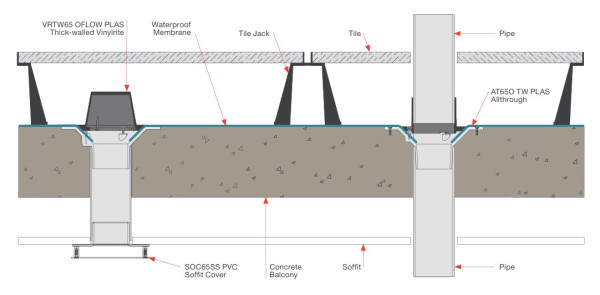
The Allthrough sleeve is an innovation that combines the required clamp ring and riser into a single ABS moulded fitting. This ensures an even clamp to the membrane and provides a riser compatible with uPVC, stainless steel, and Zincalume downpipe systems, allowing for a single product specification across various designs. The outlet directly beyond the fitting connects to a DWV pipe, which can transition to a different decorative finish below the soffit as seen below with PVC inside the soffit transitioning to Stainless Steel downpipe where visible.

For balcony-over-balcony penetrations, an open Allthrough can be utilised as both a penetration for the downpipe to pass through and a fixture to collect balcony surface drainage within one compact fitting. This reduces on-site costs by minimising penetrations, simplifying the installation process, and streamlining passive fire solutions. A single downpipe can run vertically, collecting surface water from each balcony as it passes through the levels. As there are capacity limitations with this setup, it is recommended to consult Allproof to confirm project specifications.
For high-demand installations, such as large roof areas, a closed Allthrough should be selected. A separate deck outlet can connect within the soffit or roof area to prevent splashing from the openings caused by high water flow.
Allproof manufactures a comprehensive range of open and closed Allthroughs, which are independently flow-tested and compatible with all membrane types. Developed alongside designers and installers, this system is engineered to meet all site requirements. If a custom solution is required, Allproof can fabricate bespoke systems at their Toitū-accredited New Zealand manufacturing plant, with distribution available nationwide.

 Most Popular
 Popular Products