 VANTAGE Windows & Doors
 Roofing Industries
 ALTHERM Window Systems
 Dimond Roofing
 Juralco Aluminium
 SPAX
SPAX


 Prolam
 PGH Bricks
 Metwood







 YourQS
One of our good customers rang me recently. He’d been asked “what’s your square metre rate?” by a potential client. They were talking to three builders and wanted to decide which one to work with. I’ve always said: “if you are willing to give a square metre rate, all it shows is that you don’t know what you are talking about”. But a flippant answer like this wasn’t going to help him in this situation.
He is an experienced builder; we’ve done over 50 houses with him. He mostly builds high-performance homes from SIPS. This customer was wanting a conventional frame home so was concerned that he was out of touch with the cost of these.
The discussion got me thinking; what is the best way to answer this common question?
I know that designers face a similar question daily. Most designs have some form of budget, but how do you know what can be achieved for the budget? If I am right that square metre rates are meaningless, where do you start?
Why $/m² is a common language
Square metre rates are fine if they are comparing very similar designs, in similar locations, at similar times. Back in the 90s when I first joined the construction sector, many houses were rectangular boxes, gable roof, on piles, with no garages. I have no doubt that square metre rates were reasonably accurate and did make pricing very quick. Today’s houses are anything but these.
Looking at a sample of 468 houses that we’ve worked on, this chart shows there is little correlation between cost and floor area. Pick any area, and you have a wide range of $/m² that could apply.
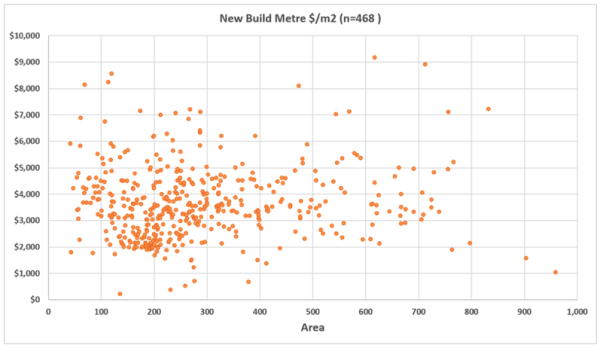
Why is this?
The reason is there are so many things that affect build cost, but don’t impact the floor area. Here are some design choices and an indication of their impact on the $/m²:
| Design Element | Approx Cost Impact $/m² floor area |
| Better floor coverings | $70 - $100 |
| Tiled bathrooms | $80 - $120 |
| Rigid air barrier | $40 |
| Cladding choices | $40 - $80 |
| Better appliances | $60 |
| Better windows | $100 - $200 |
| Foundations | Massive |
Design also impacts cost. It is easy to have a 20-30% variance in the $/m² when using the same materials and only changing building shape and size. Corners cost money. The more corners, the greater the cost. An L shaped house could have 25% more wall area than a square house. Fewer, bigger rooms, will lower the $/m². A big internal garage lowers the rate.
The underlying question is reasonable though
Homeowners need a way of understanding the value a builder will bring. What they were really asking was, can you build the house that I want for the money that I have?
Designers face the same need. Is the design affordable for the client? It is just that $/m² is not the way to meet this.
My suggestion to the builder was to pick a house that he had built recently that was roughly in the ballpark of what this client was looking for. Then take the client through the design outlining the cost and that it was $x/m². Then explain that this rate does not apply to any other house as a different design will result in different costs. I suggested that he cover the choices made in that home and their impact on the rate. This allowed him to provide a way for the client to understand value with appropriate context. It provided it in a way that educated them that $/m² wasn’t the right question to ask.
Surely AI can solve this
No doubt many potential customers are turning to AI for guidance. I have similar concerns with AI as I do with square metre rates. It is important that as an industry we can explain what the limitations are of using AI for cost indications.
Despite the name, AI is not intelligent. It has no reasoning ability. It is a massive prediction engine. Like square metre rates, it takes historical data but uses probabilities to predict an answer. Like $/m² rates, it feels credible but can be miles out.
The problem is houses are enormously variable and highly complex. Relatively small changes can have material cost impacts. A previous design may not be a good indicator for a different design.
AI is dependent on information it was trained on. There is an old IT saying GIGO — Garbage in Garbage out. The same applies for AI. No matter how advanced a program or algorithm is, it cannot magically fix bad starting data.
About Nick Clements
Nick won the inaugural NZIOB 2024 Digital Technology award for his work on 3D estimating in residential construction. He is a Registered Quantity Surveyor and chair of the NZIQS Auckland.
His business, YourQS, specialises in providing cost estimating services to residential builders, architects, and homeowners for both new build and renovation projects. They have completed over 4,000 projects since launching in 2019 working with around 350 builders nationwide.
Nick is the host of the Beyond the Guesstimate podcast where he talks with interesting people ideas on how we can improve as an industry and as businesses within it.

 Most Popular
 Popular Products