 VANTAGE Windows & Doors
 Roofing Industries
 ALTHERM Window Systems
 Dimond Roofing
 Juralco Aluminium
 dormakaba



 Prolam
 PGH Bricks
 Metwood







 YourQS
Estimating labour makes or breaks a project
I recently ran into a customer who thanked us for our work on a project. Though he said our labour was wrong, so he had the team double it. He then proceeded to tell me that they lost the $3m project by $300k. Afterwards I wondered, maybe our labour wasn’t so bad?
I get that quite a bit; builders presenting their labour as fact. Whereas the reality is, it is just as much an estimate as ours. So, who is right? The builder’s labour based on experience or our detailed labour build up refined on nearly 4,000 projects?
Labour is people doing tasks. Estimating labour comes down to three steps:
- Determining the tasks involved
- Establishing what factors drive the work on the task
- Measuring those factors
These three steps underpin all labour estimating methods. The main difference is how much you roll up the tasks. The more you combine tasks, the simpler the job appears but the more detail is lost and the broader the assumptions become.
Common labour estimating methods
Based on a project schedule: Estimate the number of weeks for each aspect, multiply by the number of staff on site.
| Good | Bad |
| Easy to understand | Requires experience on similar projects |
| Quick to do | Can be very inaccurate |
| Gives project schedule | Highly subjective. Varies widely between estimators. |
Unit rates: Allow a certain amount of time per building element.
| Good | Bad |
| Reasonably quick once set up | More time consuming to measure |
| Easy to understand | Requires manual input to reflect job specifics |
| Scalable, works on big and small jobs | Can ignore project complexity |
Based on materials: Allow a constant amount of labour against each item in a materials schedule.
| Good | Bad |
| Easy to do | Measure is time consuming |
| Reasonably detailed | If materials are wrong, so is your labour |
| Materials can be a good indicator of work | Misses activities not related to materials |
| Doesn't consider complexity |
Bottom-up task analysis: We call this activity-based costing.
| Good | Bad |
| Very detailed | Very time consuming |
| More closely reflects real-world effort involved | Requires a lot of set up |
| Highly repeatable | Requires information on each construction system |
Our experience with ceiling batten labour
When I started YourQS we used hours per m². It was easy. Measure the room area and times by the factor and you have your hours. Then builders started complaining that we weren’t allowing enough time on small rooms.
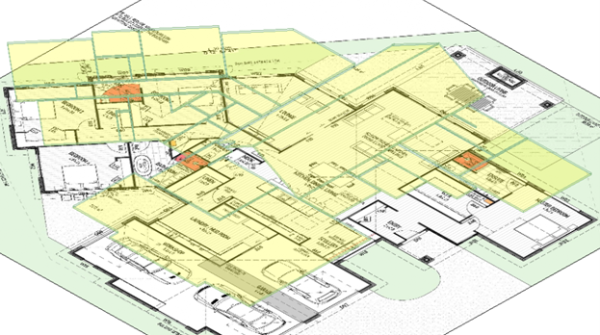
How we improved
We could have used hours per metre of ceiling batten, but that would still understate small rooms.
I could look at the house and think, “mmm that will take four people five days." But how could I train this to my team?
Instead, we turned to activity-based costing. We analyse the activities and build up the labour times based on these:
- Get the materials into the room and set up dumpy level
- x minutes per room - Install the perimeter channel/batten
- x minutes per metre of perimeter - Install battens
- x minutes per m²
Of course, the reality more nuanced than this. There are other factors like materials and build complexity to consider. We represent our knowledge like this:
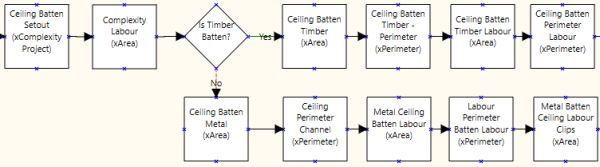
Use the power of computers
This is very time consuming to do with traditional estimating methods. By harnessing the power of computers and our 3D model, it takes us no time and gives very accurate labour hours that respond with the house design.
A last thought
Track what happened and give feedback to your estimator. It is only by closing the loop can we improve our estimates.
About Nick Clements
Nick won the inaugural NZIOB 2024 Digital Technology award for his work on 3D estimating in residential construction. He is a Member of the NZIQS and is vice chair of the Auckland committee.
His business, YourQS, specialises in providing cost estimating services to residential builders, architects, and homeowners for both new build and renovation projects. They have completed over 3,200 projects since launching in 2019 working for around 300 builders nationwide.
Nick is the host of the Beyond the Guesstimate podcast where he talks with interesting people ideas on how we can improve as an industry and as businesses within it.

 Most Popular
 Popular Products