 VANTAGE Windows & Doors
 Roofing Industries
 ALTHERM Window Systems
 Dimond Roofing
 Juralco Aluminium
 dormakaba


 Prolam
 PGH Bricks
 Metwood







 YourQS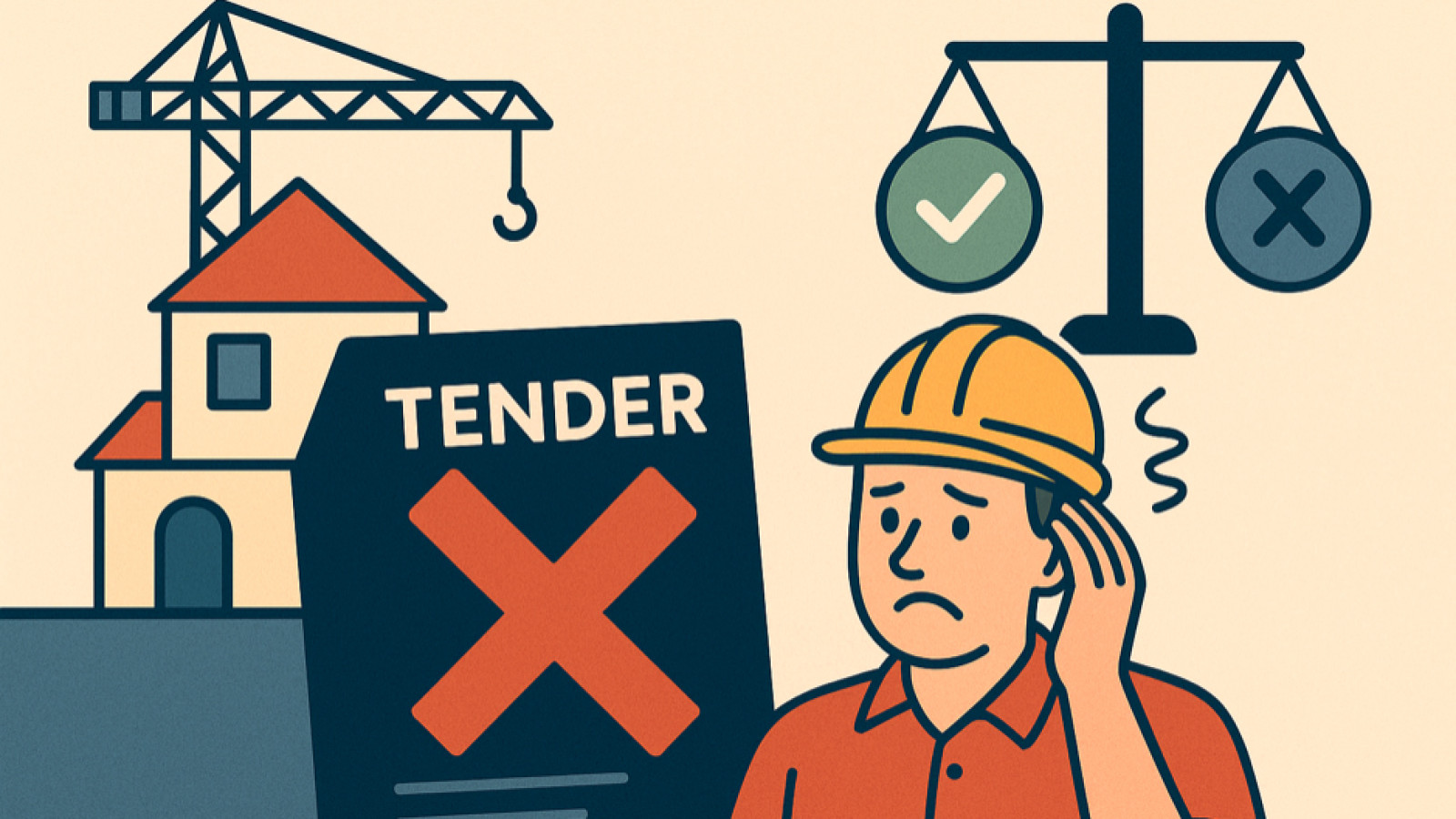
I hate tenders.
There I’ve said it. But what is more important is why do I have this dislike for them?
With the market balance swinging from in favour of builders to clients, we are seeing a greater use of tenders. In a hot market, builders are less likely to want to take on the risk and cost of tendering. In a softer market, as we are in now, the client can dictate things more. And I do get the apparent appeal of tenders.
My main beef with tenders is the fact that they are inherently inefficient. If you have three tenderers, they are all going to spend a similar amount of time and money on the tender, but of course only one can win. The other two have wasted their effort. If there are more than three, the waste is even higher.
That wasted cost is real and comes from somewhere. Most builders won’t build the cost of tendering into their bids for the fear of losing, so it comes from their profit. Over the long run, profit must cover this, otherwise they won’t be viable. The market pays in the end.
Are tenders the best way of selecting your build partner? Are you going to accept the lowest tender? Does the lowest price ever deliver the best outcome?
Other factors will be more important. Like the experience and reputation of the builder. The proposed construction timing and method. What they are like to work with. The subcontractor relationships that they bring. All are likely to be more important factors to a successful project outcome.
Yes, tenders are a means to gauge the market but there always must be doubt about the lower prices. Are they buying the work? Did they make a mistake? Will they try and make it back in the variations? What are their tags?
The worst-case scenarios that I see are tenders against concept plans. Being concepts each tenderer must make assumptions. How can you then compare them? As working drawings need a full costing, the concept tenders are 100% waste for the builder. This means it is budget checking. Tenders aren’t free, they are very expensive versus using a QS. The thing is, the cost doesn’t sit where it should: with the client.
Here's a bad example. We worked on one project with a builder at concept stage. There were five tenderers. The project came in way over the client’s budget; only about 20% of the scope proceeded. This is not fair on the builders.
Using a collaborative process gives better outcomes. One where the main parties are committed to achieving the best outcome for all. A profitable project for the builder. A happy client for the designer. A homeowner with the house that they dream of for a cost that they expect. Is starting with a tender most likely to achieve this?
A good process would look something like:
- Establish a project scope and along with what spend is affordable.
- Pay a professional to cost-check the design at concept stage against this budget. Adjust scope if needed.
- Create working drawings.
- Select a builder (can be earlier in the process).
- Work with the builder to refine the design and agree on a price. Early involvement of a good builder will help establish a sound working relationship. Plus, they can help with buildability suggestions. This can save time and money through the project. If you have concerns about the price being market competitive, get an independent costing.
- Agree on a contract form. Be it fixed price, charge up, or some other type. Ensure that the project risks locate with the right party.
- Build it. Best practice is to use an independent professional to value the work for each progress claim. This helps ensure that the money spent aligns with the work done. Then if anything goes wrong mid-build, the client isn’t in for a nasty shock when trying to continue.
Whenever I’m asked, my advice is to find a builder that you are comfortable to work with. Work with them to establish a budget, then go charge up.
About Nick Clements
Nick won the inaugural NZIOB 2024 Digital Technology award for his work on 3D estimating in residential construction. He is a Member of the NZIQS and is vice chair of the Auckland committee.
His business, YourQS, specialises in providing cost estimating services to residential builders, architects, and homeowners for both new build and renovation projects. They have completed over 3,200 projects since launching in 2019 working for around 300 builders nationwide.
Nick is the host of the Beyond the Guesstimate podcast where he talks with interesting people ideas on how we can improve as an industry and as businesses within it.

 Most Popular
 Popular Products