 VANTAGE Windows & Doors
 Roofing Industries
 ALTHERM Window Systems
 Dimond Roofing
 Juralco Aluminium
 dormakaba


 Prolam
 PGH Bricks
 Metwood







 YourQS
This article might show how sad a person I am; but I’m always thinking about process. High performing sports stars talking about following “the process”. Because process matters. If you look at the build times and costs that Simplicity Living are achieving, it is much about process.
So why are processes so important? If you want to achieve lasting change, the only way to do this is change the process.
Let’s look at my morning coffee. I have a Binford B6100 coffee machine (no brands here – nod to Tim Taylor and Tool Time for those old enough to remember) that grinds the beans, pours the coffee, and steams the milk. I’ve challenged myself to achieve the perfect morning coffee in the most efficient way. So how did I achieve this?
Let’s look at the process steps to making a good coffee:
- Grind beans
- Flush pouring head
- Tamp grind
- Pour coffee
- Empty coffee basket and wash
- Flush steamer spout
- Get milk from fridge
- Steam milk
- Pour milk into coffee
- Drink and enjoy
Of course, I must make my wife one too. So, if we do them in the above sequence, the least elapsed time is 340 seconds for two cups.
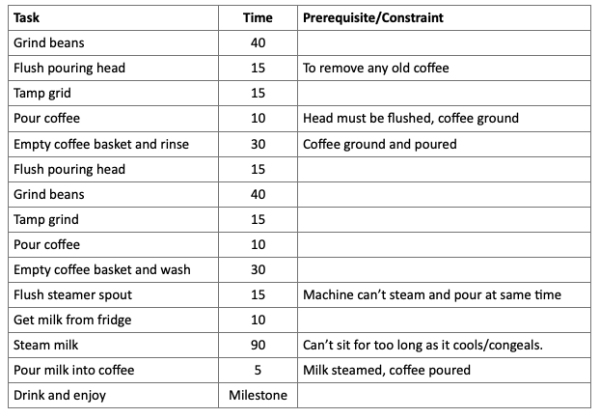
But I just can’t wait that long for a coffee. So where can we improve?
This is the timeline for the current process flow:
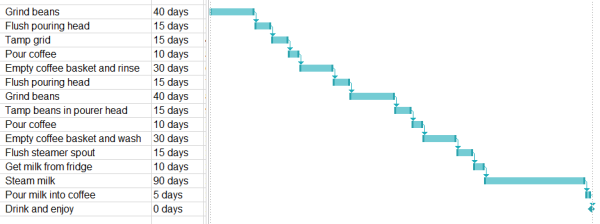
The key is performing activities concurrently. If we look at what activities can be done in parallel, we reduce the overall time. Like this:
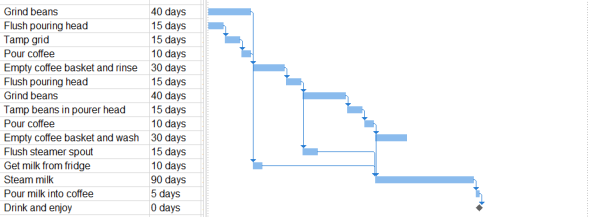
This reduces the total time down to 245 seconds, a 28% reduction. No change in what we are doing, or how long each step takes. All that changes is when we do it.
A similar approach allows Simplicity Living to achieve significant cost savings. They look for opportunities for concurrent building activities. Finding them reduces the build time. Reducing the build time has a direct impact on the cost, i.e. carrying overheads for less time, lower interest costs, income can happen sooner.
As designer, builder, and operator, Simplicity can change their design to facilitate concurrent construction. Tight coordination of their trades on site ensures that this happens.
I have no doubt that taking a similar approach to building could deliver similar benefits across the industry. There are many challenges though. Standardisation allows Simplicity to understand, manage, and refine their processes as it reduces variability (plus drives supply side cost savings). The huge variability of NZ construction takes away this predictability. It makes these improvements harder, but not impossible, to access.
About Nick Clements
Nick won the inaugural NZIOB 2024 Digital Technology award for his work on 3D estimating in residential construction. He is a Member of the NZIQS and is vice chair of the Auckland committee.
His business, YourQS, specialises in providing cost estimating services to residential builders, architects, and homeowners for both new build and renovation projects. They have completed over 3,200 projects since launching in 2019 working for around 300 builders nationwide.
Nick is the host of the Beyond the Guesstimate podcast where he talks with interesting people ideas on how we can improve as an industry and as businesses within it.

 Most Popular
 Popular Products