 VANTAGE Windows & Doors
 Roofing Industries
 ALTHERM Window Systems
 Dimond Roofing
 Juralco Aluminium
 SPAX
SPAX



 Prolam
 PGH Bricks
 Metwood







We are already seeing the fallout.
Take the recent H1 code updates for ceiling insulation. We’ve drastically bumped up the required R-values, but we haven't changed how we actually design and construct those roofs. Builders are stuffing thicker insulation into ceiling cavities, completely cutting off heat to the roof space. Without understanding how this impacts drying and durability, that cold roof space becomes a condensation trap. We are seeing a large spike in roof moisture issues right now, especially in Christchurch.
It's the leaky building crisis all over again — we are just doing it upside down.
The danger of building blind
When you don't understand the building physics behind a high-performance envelope, even minor site decisions turn into massive liabilities. Unmodelled designs routinely suffer from unintended moisture migration or turning into absolute saunas in the summer.
Here is what that looks like on site:
The insulation trap
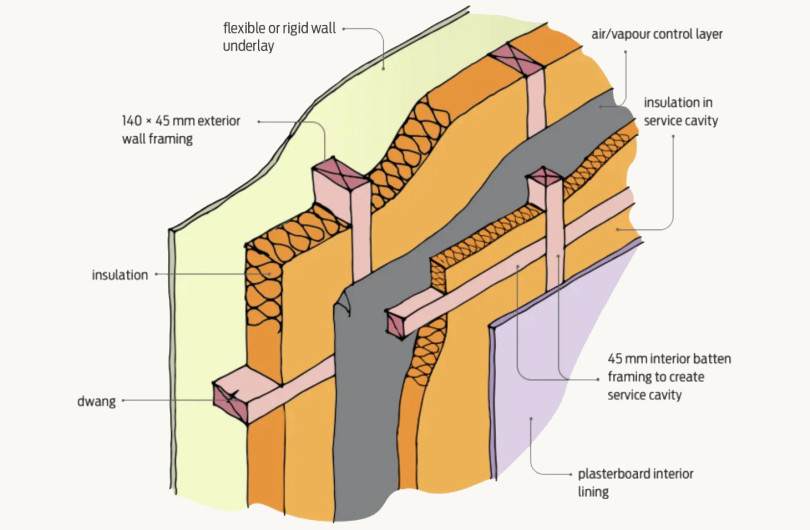
Just thickening the insulation without understanding the temperature gradient is dangerous. For example, strapping and lining concrete block or tilt panels without a proper air and vapour control layer (AVCL). Warm, humid indoor air hits that cold concrete, and suddenly you have hidden interstitial condensation growing mould.
Thermal bridges
Steel beams that cross the thermal envelope act like highways for cold. They drop the surface temperature of the wall inside the house, creating immediate condensation points and mould.
The ducting disaster
We’ve seen jobs where ventilation ducts carrying cold air through a warm interior were left uninsulated. The ducts sweated, water pooled, and the concealed damage destroyed the ceiling. The builder had to rip out and replace finished ceilings — adding thousands in unnecessary costs and blowing out the timeline.
The solar oven effect
Tight, well-insulated envelopes are brilliant at trapping heat. If the designer hasn't run the energy modelling (like the Passive House Planning Package) to optimise the glass, extensive unshaded windows could turn the home into an unliveable greenhouse in summer. The client is miserable, and you’re left dealing with the fallout and retroactive AC installations.
Product swaps
Swapping out materials on site is a massive gamble. In one recent case, a builder substituted under-slab expanded polystyrene pods for air pocket pods. It introduced internal convection currents that sucked heat straight into the ground. The house missed its performance targets, resulting in a nasty contractual dispute.
"It's the designer's fault" won't save your margin
You might argue that these are design flaws and shouldn't be the builder’s problem. But when the ceiling needs ripping down, or the client is withholding final payment because the house is sweating, whose time and money is tied up fixing it?
You need the knowledge to spot a risky design before you break ground. You need to know when to push back on an architect’s detail to protect your client’s interests, and more importantly, to protect your own business.
Stop guessing. Start verifying
You don't need a degree in physics to understand what's risky and what's not, but you do need specialised training.
That’s where Sustainable Engineering comes in. Our Certified Passive House Tradesperson (CET) course is built for the guys actually doing the work. It gives you universally applicable building science knowledge and the practical, on-site skills to execute complex envelopes flawlessly. You'll learn how to manage moisture, airtightness, and insulation so you never have to tear down a finished wall again.
(For the architects handing over the plans, our Certified Passive House Designer (CEPH) course provides the skills to predict and optimise performance long before the plans hit the site).
Protect your margins, your reputation, and your business.
Avoid costly callbacks and structural failures. Learn how to manage high-performance build liability with practical building physics courses from Sustainable Engineering.

 Most Popular
 Popular Products