 VANTAGE Windows & Doors
 Roofing Industries
 ALTHERM Window Systems
 Dimond Roofing
 Juralco Aluminium
 SPAX
SPAX



 Prolam
 PGH Bricks
 Metwood






If you've specified windows and doors from an Australian or overseas manufacturer in the past you will have almost certainly encountered documentation referring to AS 2047:2014. With MBIE's recent release of the Building Product Specification (BPS), Australian tested products are now an alternative compliance pathway, and you're likely to encounter it more. Understanding what that means and critically, where it lines up with New Zealand's test standards and wind zone classifications and where it doesn't, is no longer a specialist concern. It sits squarely in the specifier's court.
The short answer is that AS 2047 and TS 4211 are fundamentally similar documents. Both with test methodologies derived from AS/NZS 4420, both test for the similar performance characteristics, the BPS acknowledges AS 2047 as an acceptable pathway for demonstrating compliance with Building Code Clauses B1 and E2. But the detail matters and the differences, while subtle, are exactly the kind of thing that can create a consent problem or a weather-tightness failure if they're not well understood and incorrect selections are made.
What AS 2047 tests and how it rates performance
AS 2047 has a similar scope to TS 4211, covering external windows, sliding and hinged doors (including French and bi-fold), adjustable louvres, and shopfronts. Like its NZ counterpart, it rates window and door assemblies as standalone units, tested for the four performance parameters used to establish compliance: ultimate strength (ULS), deflection at serviceability limit state (SLS), water penetration resistance (WTP), and air infiltration.
The standard assigns products one of ten ratings — N1 through N6 for non-cyclonic conditions, and C1 through C4 for cyclonic. Each rating complies to a set of minimum test pressures. N1 is the lowest, N6 the highest for non-cyclonic applications. In a New Zealand context, the N-series ratings are the relevant ones, and reading those ratings against our own wind zone classifications is where you need a clear head.
How the BPS qualification works
The BPS acknowledges AS 2047 performance but does not remove the obligation for Building Code compliance. Products must be used within the scope and limitations stated in the test report. Testing must be by an ISO/IEC 17025 accredited facility. And the product must meet the serviceability limit state wind pressure, ultimate limit state wind pressure, and water penetration resistance values specified in the BPS for the building's wind zone, not just carry an N-rating label.
Reading the ratings: where AS 2047 and NZ wind zones align
The most important tool for anyone working with AS 2047 product in New Zealand is Table 1, below. This compares AS 2047 ratings against our NZ wind zone classifications on a parameter-by-parameter basis, using the lowest performing element in each category, which mirrors the way our Building Code approaches compliance.
The colour coding tells the story at a glance. Yellow is Low wind zone equivalent, blue Medium, green High pink Very High, and pale green Extra High. The red colour indicates non-compliance, which immediately highlights that neither N1 nor N2 General ratings meets any NZ wind zone requirement. What’s more, the water penetration resistance in non-exposed conditions, which only achieve a water test pressure of 150Pa, which falls below the NZ Low wind zone threshold. That is not a printing error. It means that for a large part of the installed product market in Australia, perhaps homes in sheltered suburban Melbourne or Adelaide for instance, the water performance specification simply is not suitable for use anywhere in New Zealand.
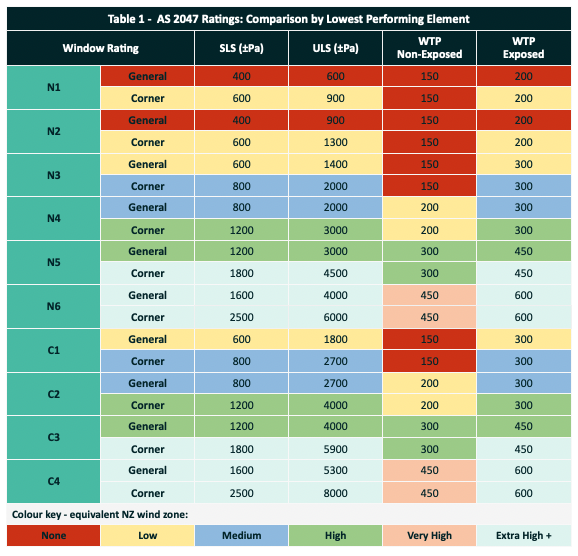
The non-exposed WTP column should be read with care. Non-exposed values of 150Pa (N1–N3, C1) sit below any NZ wind zone threshold. Always confirm the site's exposure classification and verify the appropriate WTP column applies. If in doubt, specify for Exposed conditions.
The practical read for a designer: an N3 General rated window (not corner) on a High wind zone site in New Zealand does not comply, its 600Pa SLS rating falls short of the High zone requirement. A window with an N4 Corner gets you into a High zone based on the SLS and ULS performance values, but only if water performance is confirmed as Exposed. An N5 or N6 rating gives you clear coverage for Very High and Extra High conditions respectively. Corner windows are assessed against higher pressures, and the table addresses General and Corner separately for this reason.
The deflection difference and why it matters with hinged doors
One area where the standards genuinely diverge in a way that demands a second look is deflection under SLS loading. For windows and sliding doors, AS 2047 is a little stricter as it only allows a deflection ratio of span/250 against TS 4211's span/200. That's 4mm versus 5mm per metre of span. In practice, an AS 2047-tested window will be slightly stiffer, which is no disadvantage.
Hinged and non-sliding doors are a different story. AS 2047 allows a much softer span/100 (10mm per metre of span) where TS 4211 requires the same span/200 ratio as any other structural member. This means an AS 2047 test report for a hinged door cannot be assumed to demonstrate compliance with the New Zealand deflection requirement without reverting to the raw test data. The test report will contain the actual recorded deflection values, and a competent technical person can reverse engineer the span ratio from those figures. If you're specifying a large-format hinged door from an Australian supplier, this is a check worth making before consent.

Air infiltration — not a direct one-to-one
AS 2047 uses a two-level air infiltration classification: Low (≤1.0 L/s.m² at ±75Pa) and High (≤5.0 L/s.m² at +75Pa positive direction only). New Zealand's TS 4211 uses a four-class system tested at two pressure steps, 75Pa and 150Pa, with the results plotted to establish the class rating, a methodology following the European standards. The mapping in the table below is based on the 75Pa step only and should be treated accordingly.

NZ Class 1 and Class 4 have no direct AS 2047 equivalent. Class 4 is more stringent than AS 2047's Low rating; Class 1 is less stringent than AS 2047's High rating. For projects where air infiltration performance is critical such as passive house, high-performance residential, or air managed commercial projects, verify the test report values directly rather than relying on the classification label alone.
Installation: The compliance that the rating doesn't cover
There is another point that must be considered, because it can get lost in the focus on ratings: a window or door rating, under either standard, applies to the unit in isolation. It says nothing about how it is to be installed and indeed whether the product is suitable for the building construction it is being specified for.
In New Zealand, residential window installation is led by E2/AS1. If an imported product's perimeter frame design doesn't align with E2/AS1 installation details, which is not uncommon with European or North American products where the frame profiles and integration methods differ, then alternative installation details will be required to demonstrate Building Code compliance. That's a design and documentation task that sits with the architect/designer. The structural and weather performance rating of the unit itself is only one part of the compliance picture; how water is managed at the interface between the window frame and the surrounding building envelope is equally critical and entirely separate from what the rating label tells you.
The practical summary for specifiers
AS 2047 is a legitimate compliance pathway for NZ projects under the BPS, but it requires active interpretation rather than passive acceptance of a label. Check the rating against Table 1 for your site's wind zone. Confirm corner window status where applicable. Verify the water penetration test pressure matches your site's exposure. Review hinged door deflection data in the test report. Confirm air infiltration values against NZ class requirements if performance is critical. And always check that your installation details comply with Clause E2, a compliant product installed non-compliantly is still non-compliant.
This article summarises material from the Window & Glass Association NZ guide to Understanding International Window Performance Standards (Version 2.2, December 2025). The full guide, including all comparative tables and test method detail, is available at wganz.org.nz.

 Most Popular
 Popular Products