 VANTAGE Windows & Doors
 Roofing Industries
 ALTHERM Window Systems
 Dimond Roofing
 Juralco Aluminium
 SPAX
SPAX



 Prolam
 PGH Bricks
 Metwood







 EBOSS
EBOSS
Yesterday: A record decline in residential completions
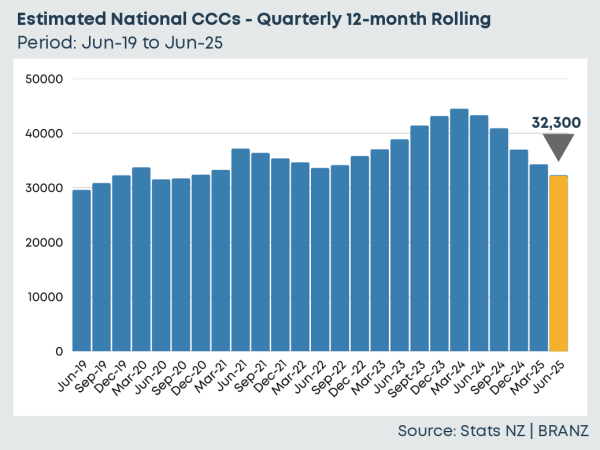
The most striking message from Yesterday is how steeply completions have fallen. Nationally, residential completions to June 2025 are estimated by the BRANZ/EBOSS model to at 32,300 — a 25% drop year-on-year. Auckland’s rate of turning approvals into finished homes has plunged, with just 59% of projects completed within two years, the lowest on record. This means roughly 4,500 Auckland consents — 16% of approvals — are inactive and not progressing.
While construction costs are stabilising with inflation falling to 0.8% in the June quarter, that hasn’t translated into increased activity. Total construction expenditure has slipped 6.8% year-on-year, with residential work down 12%. Slower debt collection, higher insolvency risk and high housing inventory have created a cautious environment despite lower borrowing costs.
In short, the sector is shrinking back to pre-COVID levels of activity, and the post-boom adjustment still has further to run into 2026.
2. Today: Signs of stability beneath the surface
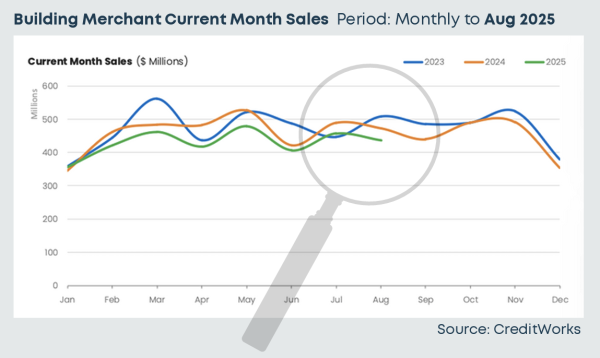
The Today section gives a more nuanced view; the downturn is real, but not uniform. Building merchant sales in August 2025 were 7.6% lower than a year ago, yet early September data hints at a 6-7% rebound, suggesting possible seasonal relief. Electrical and plumbing merchants have shown resilience (down just 3.6% and up 5.5% respectively), indicating that some construction segments are holding firm.
Still, stress remains. Debt collection times are lengthening, and IRD-driven winding-up applications now account for 78% of filings, underscoring cash-flow pressure on contractors. Concrete sales — a strong barometer of new construction starts — fell 15.4% year-on-year, confirming that the pipeline of new work is thinning.
Interestingly, while building consents have stabilised around 33,700 per year, the volume of concrete poured continues to fall, meaning fewer projects are physically commencing. That divergence between intent and action is one to watch.
Together, these indicators depict an industry that’s stopped falling but hasn’t quite started rising — a bit of a holding pattern between resilience and risk.
3. Tomorrow: A plateau in consents, but regional and sectoral shifts emerging
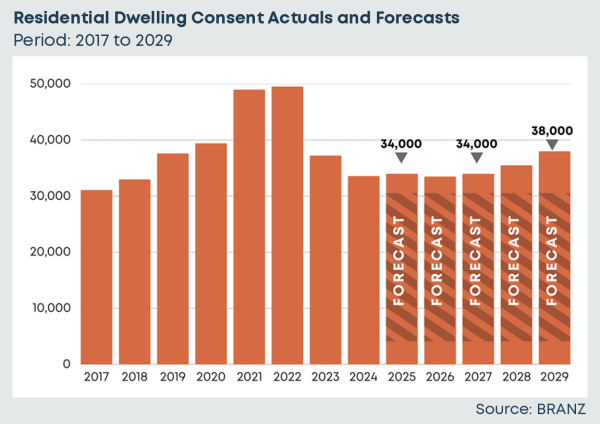
Looking ahead to Tomorrow, the picture is one of stabilisation rather than recovery. Residential consent approvals have flattened at roughly 34,000 a year, almost unchanged from 2024. That’s down from the 2023 boom but suggests the bottom is very much in sight. South Island regions continue to lead in consents per capita, with Canterbury (9.6) and Otago (9.7) well above the national average of 6.4, while most North Island regions are static.
More concerning is the drop in government-funded housing activity: social-housing consents have plunged to 4% of total approvals, down from 9.5% a year ago, and Auckland’s Kāinga Ora consents are 90% below 2023 levels. The shift toward Community Housing Providers is underway but still small, with 1,028 homes approved under the new model to date.
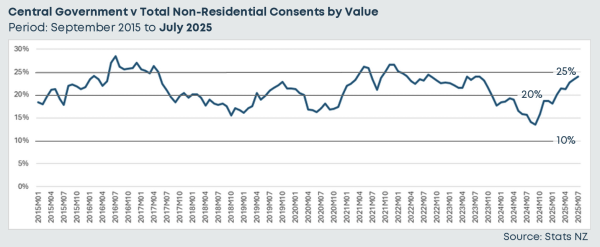
On the non-residential side, the Government’s share of total consent value has rebounded to 25% from a 14% low, driven by $2 billion of education and health approvals, reversing last year’s pause on state-funded projects. Commercial buildings dominate consent volumes, but most are alterations and fit-outs rather than new builds — perhaps a sign that owners are upgrading rather than expanding.
4. Future: Interest rate easing to drive a slow, uneven recovery
The Future section delivers the cautiously optimistic note of the report. The Official Cash Rate has been cut to 2.5%, with markets fully pricing another 25-basis-point cut before year-end. Bank funding costs (swap rates) continue to fall, implying mortgage rates in the low 4% range by mid-2026.
Historically, lower mortgage rates drive a rise in building consents within three months, and early data hints at that pattern re-emerging. Yet any rebound will be constrained by high housing inventory, modest migration and soft labour markets.
Migration, a major long-term driver of housing demand, is improving — annual inflows to July 2025 reached +19,200, up from lows of 7,000 in 2024 — but still far below the levels needed to sustain current consent volumes.
Affordability is improving but still stretched: mortgage payments consume 36% of disposable income, down 4 points this year but above the long-term 33% average. The BRANZ forecast suggests residential consents will plateau around 33,500 for the next 2 - 3 years, with multi-unit dwellings making up 53% of new homes.
Non-residential activity looks more robust, underpinned by private projects and renewed government spending, especially the $7.7 billion Health NZ infrastructure programme and the $413 million school build package that includes faster, standardised classroom designs.
In summary
The next 12 months will test how quickly easing credit conditions can offset structural challenges, from affordability to population growth. For suppliers, designers and policymakers alike, the key will be recognising where demand stabilises first, and being ready when the rebound begins. And let’s not forget, the incumbent Government will be seeking re-election in this period too… so watch this space!

 Most Popular
 Popular Products