 VANTAGE Windows & Doors
 Roofing Industries
 ALTHERM Window Systems
 Dimond Roofing
 Juralco Aluminium
 SPAX
SPAX



 Prolam
 PGH Bricks
 Metwood







 EBOSS
EBOSS
I believe we’ve arrived at an important inflection point — below are my impressions of the most important signals to make sense of the year ahead.
1. Completions have bottomed — the cycle is turning
The dominant story in the “Work Completed” data is that residential construction has significantly contracted — but is likely at, or very near, the bottom of the cycle.
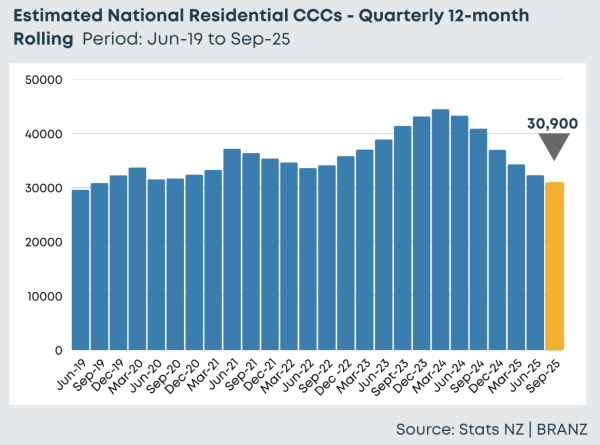
From EBOSS/BRANZ estimation modelling, national residential completions fell to 30,900 dwellings in the year to September 2025, down -24% year-on-year (see page 4). Quarterly rolling 12-month declines through 2025 confirm the downturn, though Auckland’s most recent data suggests stabilisation, with the September quarter marking the second consecutive quarter of growth in completions from the March 2025 low.
Measured by expenditure, construction activity overall fell -5.2% year-on-year, with residential down -9% (page 5). Yet at the same time, several leading indicators improved late in 2025:
- Mortgage lending surged in December (+60% month-on-month - page 6)
- Residential sales volumes lifted +4.6% year-on-year (page 6).
- Construction cost inflation rose only slightly to just 1.2% (page 7), restoring predictability for future project feasibility
Together, these signals suggest the supply-side contraction phase has largely run its course
2. Activity is stabilising — early signs of recovery emerging
The “Work Under Construction” section points to improving momentum in live activity — particularly in merchant data and sentiment.
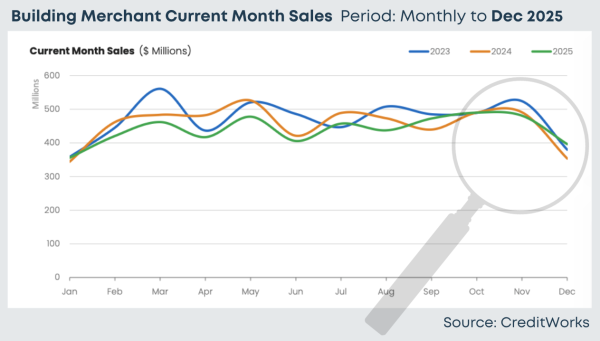
December 2025 merchant sales were notably strong when compared with previous Decembers:
- Building merchants: +12.1% YoY (page 8)
- Electrical merchants: +13% YoY
- Plumbing merchants: +15.5% YoY
Importantly, CreditWorks’ Days Sales Outstanding remained contained below 2024 levels (page 9), likely due to tighter credit management and (hopefully) healthier balance sheets.
Concrete sales — often a reliable barometer of confirmed activity — show tentative recovery, with ready-mix volumes ticking up across mid-to-late 2025 (page 9).
At the same time, Forsyth Barr’s February 2026 sentiment survey showed a sharp turnaround, with a net +36% of firms expecting profit increases in 2025 — a significant shift from previous pessimism.
While insolvency activity remains elevated, the weight of evidence suggests construction is moving from stabilisation into early recovery.
3. The pipeline is rebuilding — but unevenly
The clearest signal in the “Work Consented” stage is that intent to build has strengthened.
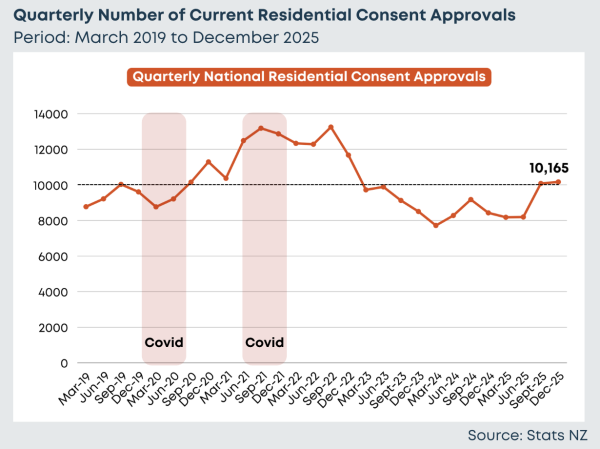
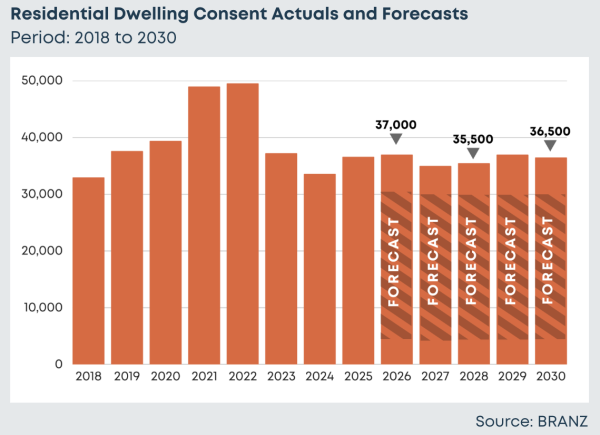
Residential consents rose +9% in 2025, equating to roughly 3,000 additional homes compared to 2024 (page 11). The final two quarters of 2025 exceeded pre-Covid peaks, with annual consenting reaching 36,600 dwellings.
Auckland contributed more than half of the annual growth, while nationally consents per 1,000 population rose from 6.3 to 6.9 (page 12).
However, underlying demand fundamentals remain mixed:
- Net migration fell to 14,200 in 2025, the lowest calendar year since 2013 (page 17).
- Rental listings are at 10-year highs, limiting rent inflation, and possible investor activity.
- Government-funded social housing has now levelled off at circa 4% of total consents (down from 9.5% in mid-2024), with Community Housing Providers (CHPs) slow to make impact.
In non-residential, total consents reached $8.9bn in 2025, down -4.6% YoY (page 13). Education consents surged +27% amid a new standardised design approach, while Health consents stuttered down -43% for the year, but a strong multi-billion dollar programme of key hospital development remains in place.
The pipeline is stabilising and modestly expanding — but its durability depends heavily on migration, rates and government spending decisions in a year that sees the current administration going to the polls in November.
4. Interest rates, migration and affordability — and a dollop of politics — will define the next phase
The final section of The Pulse moves beyond consented work to macroeconomic drivers that will determine the next construction upswing.
The RBNZ cut the OCR to 2.25% in November 2025, likely marking the end of the easing cycle (page 15). Markets are already pricing rate increases from mid-2026, with forecasts implying mortgage rates in the mid-5% range.
Historically, residential consents show a strong inverse relationship to mortgage rates (page 16). With swap rates rising and bank funding costs increasing, housing demand may face renewed pressure.
Affordability has improved from the 2023 peak, but mortgage repayments still account for approximately 35% of household income, above the long-run average of 33% (page 18).
Migration remains the critical medium-term variable. Based on historical relationships, current migration settings imply demand for around 25,000 dwellings per year — below present consent levels (page 17). Migration would need to more than double from 2025 levels to justify current pipeline volumes.
BRANZ forecasts consents remaining stable through 2026 before dipping in 2027 as rates rise (page 19). Multi-unit dwellings are comfortably expected to represent the majority of consents by 2030, at 55%.
And Auckland’s densification direction under Plan Change (PC)120 has become, for now at least, a political football. National last week walked back densification numbers to 1.6m new homes (from 2m) saying leafy suburbs would be spared, and instead the focus will be sites near the CBD, Rail Link and major transport corridors.
In summary
Considered together, the signals point to a sector completing its reset and edging into a new phase of cautiously renewed growth. The contraction in completions appears to have run its course, on‑site activity is firming, and intent to build is returning — though unevenly. Yet this recovery rests on sensitive foundations: interest rate stability, stronger migration, and a consistent political direction on housing and infrastructure.

 Most Popular
 Popular Products